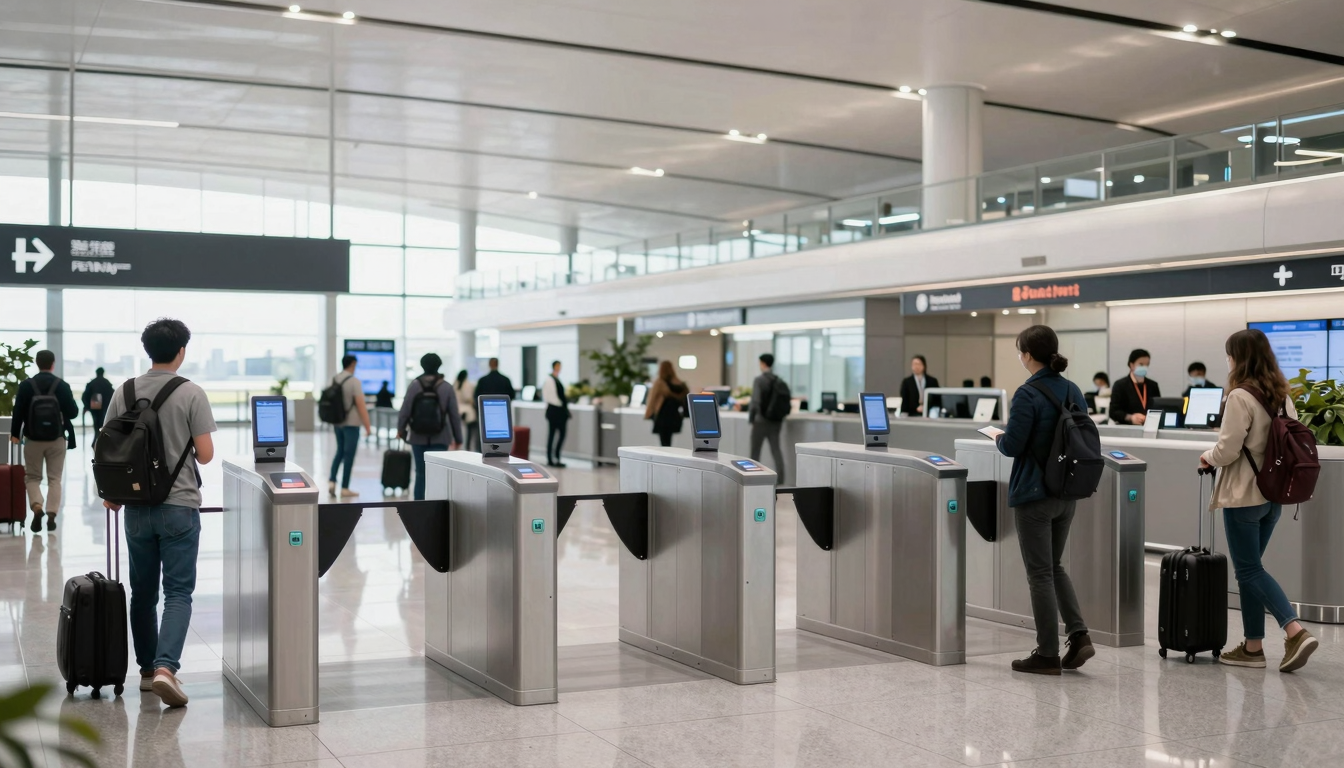
How your passport gets checked at Fiumicino depends mostly on your nationality and passport type, thanks to a large e-gate program — and a newer biometric registration step for many non-EU arrivals.
E-gates
E-gates are available to EU/Italian citizens aged 12 and over, and to e-passport holders from 30+ other countries, including Australia, Canada, Japan, New Zealand, Singapore, and the United States. The passport is scanned and matched to your face via the chip photo, taking around 20 seconds per person — Aeroporti di Roma states this is roughly 50% faster than a manual check. The e-gate network spans Aeroporti di Roma's airports (FCO and Ciampino) with 77 gates in total.
Staffed passport control
Travelers who aren't eligible for e-gates — most non-EU passport holders outside the eligible list — go through staffed booths instead.
The Entry/Exit System (EES)
Since 12 October 2025, the EU's Entry/Exit System has added biometric registration (fingerprints and photo) for most non-EU nationals on short stays at Fiumicino, processed through a network of 210 self-service kiosks, with access rolling out progressively for eligible biometric-passport holders 12 and over.
Customs
Standard EU customs rules apply on arrival — declare anything over the duty-free allowance, and use the green/red channel system as at any other EU international arrival.
Declaring goods and duty-free allowances
Travelers arriving from outside the EU with goods above the standard duty-free thresholds (covering alcohol, tobacco, and general goods value) should use the red channel and declare them proactively rather than risk a spot check finding undeclared items in the green channel — the specific allowance thresholds are set by Italian and EU customs law and are worth checking before you fly if you're carrying anything close to the limit.
What happens if you're flagged for a manual check
Occasionally a passenger using an e-gate or an EES kiosk will be redirected to a staffed booth for a manual check — this can happen for a range of routine reasons (a document that doesn't scan cleanly, a first-time biometric registration, or a random compliance check) and isn't necessarily a sign of a problem. Staying with your documents ready and answering questions directly is the fastest way through it.